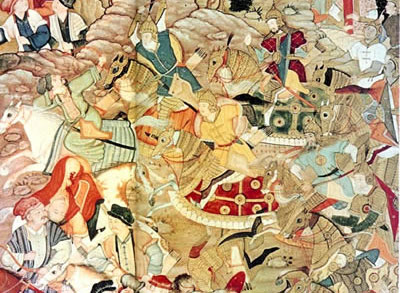
Illustration from History of the Moghuls, a 17th-century Indian text (detail), Gulestan Palace Library, Tehran
Chinggis Khan personally led three invasions. In each case, an economic issue was involved.
In 1209, Chinggis set forth on a campaign against the Tanguts, who had established a Chinese-style dynasty known as the Xia, in Northwest China, along the old silk roads. The Tanguts had become involved in a trade dispute with the Mongols. Chinggis quickly overwhelmed the Tanguts, received what he wanted in terms of a reduction of the tariffs the Tanguts imposed on trade, and returned to Mongolia. He did not capitalize upon his victory, this time, to expand the Mongols' territory.
The second campaign was against the Jin dynasty of North China, which controlled China down to the Yangtze River. The Jin were a people from Manchuria and were actually the ancestors of the Manchus. They too had become involved in a trade dispute with the Mongols, and the result was an attack by the Mongols, who desperately needed the products the Jin produced. By 1215, Chinggis's troops had seized the area now known as Beijing and defeated the Jin, forcing them to move their capital south. Chinggis had what he wanted in terms of additional trade — again, he returned to Mongolia.
The third campaign was initiated because of the murder of envoys Chinggis had sent to Central Asia.
The shah of Central Asia, not knowing anything about Chinggis or the Mongols, killed the envoys for being insolent enough to request changes in the conditions of trade between the Mongols and the Central Asians. From the Mongol standpoint, the murder of the ambassadors was the most heinous of crimes, and this campaign against Central Asia was first and foremost an act of revenge.
After devoting considerable time to logistical planning, Chinggis organized a major force and finally set forth against Central Asia in 1219. This would be the most devastating of his campaigns. Both sides engaged in mass slaughter, and it took several years for Chinggis to successfully penetrate and conquer the great centers of Central Asia. And when he left Central Asia in 1225, Chinggis didn't pull out all his forces as he had in his previous campaigns. This time, Chinggis left behind Mongol troops to occupy the lands he had conquered.
In 1227, still making his way back to Mongolia, Chinggis Khan died.
Related Topic: Key Figures in Mongol History: The Death of Chinggis Khan
Illustration from History of the Moghuls, a 17th-century Indian text (detail), Gulestan Palace Library, Tehran