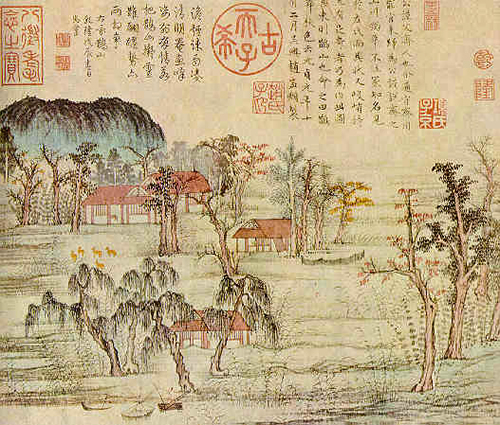
Autumn Colors on the Ch'iao and Hua Mountains by Zhao Mengfu (1254-1322), National Palace Museum, Taipei
The Mongols gave strong support to the peasants and peasant economy of China, believing that the success of the peasant economy would bring in additional tax revenues and ultimately benefit the Mongols themselves.
Relief measures — including tax remissions, as well as granaries for the storage of surplus grain — were thus provided for peasant farmers in North China, in the areas that had been devastated during the war between the Mongols and the Chinese. And early in their reign, in 1262, the Mongols prohibited the nomads' animals from roaming in the farmlands and thereby undermining the peasant economy.
The Mongols also sought to help the peasants organize themselves and initiated a cooperative rural organization — a self-help organization comprising about 50 households under the direction of a village leader.
These rural cooperatives had as their principle purpose the stimulation of agricultural production and the promotion of land reclamation. The village/cooperative leader had the task of guiding and helping his organization through everything from farming, planting trees, and opening up barren areas, to improving measures for flood control and increasing silk production. In addition, the cooperatives conducted a periodic census and assisted in surveillance over recalcitrant Chinese and other possible saboteurs of Mongol rule. They also served as a kind of charity granary to assist the unfortunate during poor harvests or droughts, providing food and other supplies to orphans, widows, and the elderly.
The Mongols also devised a fixed system of taxation for the peasants. Rather than having to anticipate unpredictable and extraordinary levies, as in the past system they had much resented, peasants under the Mongol system could know exactly how much would be required of them.
Perhaps the one area in which the Mongols did not much take into account the interests of the peasantry was labor obligations. During their rule the Mongols embarked on a series of extraordinary public works projects throughout China, including the extension of the Grand Canal to Daidu (present-day Beijing), a vast postal-station system, and the building of a capital city in Daidu. All these projects required vast investments of labor, and most of this labor was recruited from the peasantry. This policy became one that generated much animosity from the peasant ranks. [Also see The Beginnings of Mongol Collapse: Public Works Failures]
Autumn Colors on the Ch'iao and Hua Mountains by Zhao Mengfu (1254-1322), National Palace Museum, Taipei