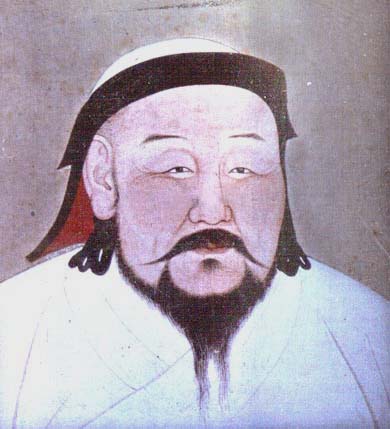
National Palace Museum, Taipei, Taiwan
Khubilai Khan was an important transitional figure in Mongol history, in particular because he sought to rule — and not merely conquer — the vast domains that the Mongols had subjugated.
Among other things, Khubilai Khan:
• established an administration to govern China
• supported agriculture, trade, and crafts
• patronized painting, the decorative arts, and theater
• provided funds and support for Buddhist monasteries, Confucian scholarship, Islamic mosques, and Nestorian Christian churches
This is not to say that Khubilai did not persist in efforts at military expansionism — indeed, he successfully brought South China under his control in 1279. But his three naval campaigns — two against Japan, in 1274 and 1281, and one against Java in 1292-3 — failed disastrously and led to the eventual collapse of Mongol power in China in 1368.
For more on Khubilai Khan's rule in China, see:
The Mongols in China: Khubilai Khan in China
For more on Khubilai's failed military campaigns, see:
The Mongols in China: Military Successes & Failures
Two key figures closely related to Khubilai Khan include Chabi, his second principal wife, and the Tibetan monk 'Phags-pa lama, who was his close friend and adviser.
Read Marco Polo's Descriptions of Khubilai Khan and His Court:
[Text excerpted from The Book of Ser Marco Polo: The Venetian Concerning Kingdoms and Marvels of the East, translated and edited by Colonel Sir Henry Yule]
• Chapter VIII: Concerning the Person of the Great Kaan [PDF]
A physical description of Khubilai Khan, and general descriptions of his family, his court, and his concubines
• Chapter IX: Concerning the Great Kaan's Sons [PDF]
Descriptions of Khubilai Khan's twenty-two sons