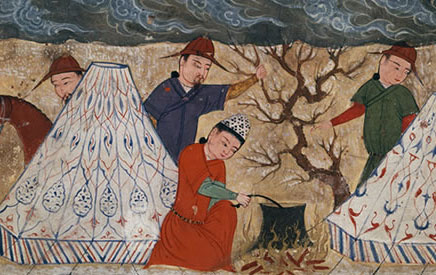
Khubilai Khan and Chabi on a Cookout (detail), Bibliothèque nationale de France, Paris
The most numerous and valuable of the Mongols' principal animals, sheep provided food, clothing, and shelter for Mongol families. Boiled mutton was an integral part of the Mongol diet, and wool and animal skins were the materials from which the Mongols fashioned their garments, as well as their homes. Wool was pressed into felt and then either made into clothing, rugs, and blankets or used for the outer covering of the gers [or tents].
Dried sheep dung was collected and used for fuel. Though the Mongols used wood and currently also use coal as fuel sources, animal dung was often the most readily available source. Women, and secondarily children, were responsible for gathering the dung.
Survival of young sheep (and other animals) was vital to maintaining the pastoral-nomadic way of life, and a significant responsibility for Mongol women was to coax the ewes to nurse their young.
"Khubilai Khan and the Women in His Family," by Morris Rossabi, in Studia Sino-Mongolica: Festschrift fur Herbert Franke, W. Bauer, ed. (Wiesbaden: Franz Steiner Verlag, GMBH, 1979) 153-180.
Khubilai Khan and Chabi on a Cookout (detail), Bibliothèque nationale de France, Paris