Key Figures in Mongol History
Chinggis Khan's Four Great Legacies
Tolerance
One of Chinggis Khan's greatest legacies was the principle of religious tolerance. In general, Chinggis provided tax relief to Buddhist monasteries and to a variety of other religious institutions. And though Chinggis himself never converted to any of the religions of the sedentary peoples he conquered (he remained loyal to Mongolian shamanism), he was quite interested in Daoism, particularly because of the Daoists' pledge that they could prolong life. In fact, on his expedition to Central Asia Chinggis was accompanied by Changchun, a Daoist sage from China, who kept an account of his travels with his Mongol patron. Changchun's first-hand account has become one of the major primary sources on Chinggis Khan and the Mongols. [Also see The Mongols in China: Religious Life under Mongol Rule, to compare Chinggis's legacy to Khubilai Khan's policy of religious tolerance.]
Written Language
The creation of the first Mongol written language was another legacy of Chinggis Khan. In 1204, even before he gained the title of "Chinggis Khan," Chinggis assigned one of his Uyghur retainers to develop a written language for the Mongols based upon the Uyghur script. [Also see The Mongols in China: Cultural Life under Mongol Rule, to compare Chinggis's legacy to Khubilai Khan's commissioning of a Mongol script.]
Trade and Crafts
A third legacy was Chinggis's support for both trade and crafts, which meant support for the merchants and artisans in the business of trade and craft. Chinggis recognized early on the importance of trade and crafts for the economic survival of the Mongols and actively supported both. [Also see The Mongols in China: Life for Artisans under Mongol Rule and Life for Merchants under Mongol Rule, to compare Chinggis's legacy to Khubilai Khan's support artisans and merchants.]
Legal Code
Chinggis also left behind a legal code, the so-called Jasagh, which consisted of a series of general moral injunctions and laws. The Jasagh also prescribed punishments for transgressions of laws relating particularly to pastoral-nomadic society.
→ NEXT: Chinggis's Death
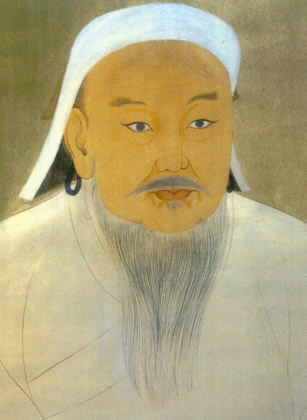
National Palace Museum, Taipei, Taiwan