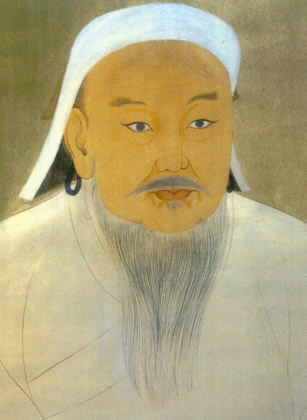
National Palace Museum, Taipei, Taiwan
More has been written about Chinggis Khan than perhaps any figure in Asian history, but much of this has been misleading, inaccurate, or prejudicial. Many Westerners accept the stereotype of Chinggis as a barbaric plunderer intent on maiming, slaughtering, and destroying other peoples and civilizations. To the Mongols, however, Chinggis Khan is a great national hero who united all the Mongol tribes and carved out the largest contiguous land empire in world history. And according to this latter view, Chinggis and his descendants promoted frequent and extended contacts among the civilizations of Europe and Asia, ushering in an era of extraordinary interaction of goods, ideas, religions, and technology.
Often based on secondary accounts and myths that cannot be attested, these divergent views usually bear scant relation to what we find in the limited primary sources on Chinggis Khan that have survived to this day. Many Westerners are unaware, for instance, that "Chinggis Khan" is a title and that his birth name was Temujin. In addition, no contemporaneous portrait of Chinggis Khan has survived in any painting or in any other visual media.
Surprisingly few reliable accounts about Chinggis Khan have been discovered. The Secret History of the Mongols* is one that presents a contemporaneous Mongol perspective. The author (or authors) are anonymous, and the date of the work's completion is unknown, but it is certainly a 13th-century work and offers, together with self-serving myths, the most complete account of Chinggis's life and career.
The Persian historian and official Ala-ad-Din Ata-Malik Juvaini (1226?-1283), who served at the Mongol court in West Asia, wrote the best description of Chinggis's campaigns**. His work is generally judicious — it is (in his own words) "on the one hand, [a] candid recital of Mongol atrocities, [a] lament for the extinction of learning, [a] thinly veiled criticism of the conquerors and ... [an] open admiration of their vanquished opponents; and on the other hand, [in] praise of Mongol institutions and Mongol rulers and [a] justification of the invasion as an act of divine grace."
Chinggis also invited a Daoist sage named Changchun to accompany him on his campaigns to Central Asia, and he wrote a fine, first-hand description of his Mongol patron*** that yields fascinating insights into his personality.
The best modern work on Chinggis Khan is Genghis Khan: His Life and Legacy by Paul Ratchnevsky, trans. by Thomas Haining (Oxford: Blackwell, 1991).
*The most accessible translation in English of the The Secret History .. is by Urgunge Onon, The History and the Life of Chinggis Khan, (Leiden: E.J. Brill, 1990). A more scholarly translation is by Igor de Rachewiltz in the Papers on Far Eastern History IV-XXXIII (1971-86).
**The best and most readable translation of Juvaini's work is by John A. Boyle, History of the World Conqueror (Seattle: University of Washington Press, 1997)
***Arthur Waley offers an excellent translation of Changchun's account in The Travels of an Alchemist (London: Routledge & Kegan Paul, 1931)
National Palace Museum, Taipei, Taiwan