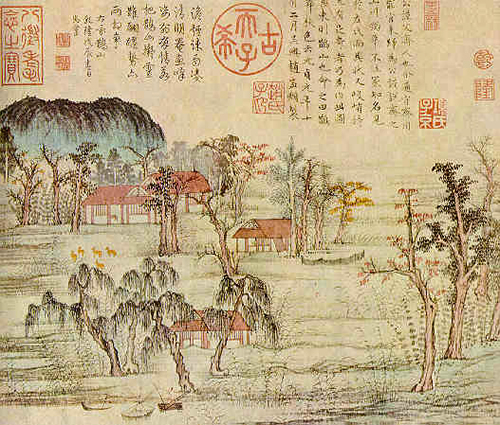
Autumn Colors on the Ch'iao and Hua Mountains by Zhao Mengfu (1254-1322), National Palace Museum, Taipei
An important legacy of the Mongols' reign in China was their support of many religions.
Islam, for example, was well supported, and the Mongols built quite a number of mosques in China. The Mongols also recruited and employed Islamic financial administrators — a move that led to good relations with the Islamic world beyond China, in particular with Persia and West Asia. [Also see The Mongols' Mark on Global History: Relations with Islam]
The Mongols were also captivated by Buddhism — particularly the Tibetan form of Buddhism — and they recruited a number of Tibetan monks to help them rule China and promote the interests of Buddhism. The most important of these monks was the Tibetan 'Phags-pa Lama. This policy resulted in an astonishing increase in the number of Buddhist monasteries in China, as well as in the translation of Buddhist texts.
Even Nestorian Christianity was promoted by the Mongols, partly because Khubilai Khan's own mother was an adherent of that faith.
There was one religion, however, that did not have Mongol support: Daoism. Daoism was at that time embroiled in a struggle with Buddhism that often flared into actual pitched battles between the monks of the two religions. The Mongols, siding with the Buddhists, did not look favorably upon the Daoists. In fact, at a meeting in 1281 where Buddhist and Daoist monks debated the merits of their individual religions, Khubilai Khan supported the Buddhists and imposed severe limits on Daoism. As a result of this meeting, a considerable number of Daoist monasteries were converted into Buddhist monasteries, some Daoist monks were defrocked, and some of the wealth and property of the Daoists was taken over either by the Mongol state or by Buddhist monasteries. [Chinggis Khan, on the other hand, favored Daoism. Read more about Chinggis Khan's Legacy of Religious Tolerance]
For more on the Mongols' tactic of religious tolerance, see:
• The Mongols' Mark on Global History: Religious Tolerance
Autumn Colors on the Ch'iao and Hua Mountains by Zhao Mengfu (1254-1322), National Palace Museum, Taipei